Showing posts with label Wine. Show all posts

Tuesday, May 3, 2011

Decorating with Wine Corks

This weekend, I was in the mood to be a little crafty but didn't have any grand project ideas. But do you know what I did have?

Wine corks.

A ton of 'em.

If you've seen the wine label collage I've done, you know that we really love wine. And with a ton of wine labels, comes a ton of wine corks.

I've saved all the wine corks in hopes that someday I'll find some inspiration to use them in some capacity, but for now they just fill up our vases and glass bowls as decoration.

This weekend I decided to use just a handful of them to add a little character to our bar tray. If you recall, I repurposed these wine bottles into glass-etched liquor bottles:

edited Glass etching liquor bottles (6)


I decided that black tray on our black chest looked a little bland. So, to further tie in the wine theme we've got going, I decided to add some wine corks. Initially, I lined them up along the inside rim like so:

Wine corks 1


The only problem with this method is that the bottoms of corks are not perfectly flat, so they all kept falling over.

So I grabbed my glue gun!

Wine corks 2


Now, I didn't want this to be a permanent addition to the tray, so I just wanted to glue them together in order so that they could stand, but not glue them directly to the tray itself. My first thought was to glue them all together. However, as I started to glue, I realized that the longer I made the wall of corks, the more likely it would be to break. Hot glue worked well but because corks are so smooth, it wouldn't be too difficult to break the wall of corks. That's why I decided to just do rows of 5-6 corks each. These rows had enough reinforcement from the 5-6 in order to stay standing, but weren't so long that they would break apart.

Wine corks 3


I also decided to do some corks with the red wine-stained side up, sporadically to give them a little more charm.

Then I lined the four pieces of wine corks up in a row at the back of the wine tray, and they look great!

Wine corks 4


They stand up just fine, and provide a nice backdrop for the liquor bottles on the black tray. And best of all, they continue the wine theme without being over-the-top!

Monday, March 7, 2011

Date Night :: Scallops

Sometimes, Chris and I find ourselves wanting to get a little more adventurous in the kitchen, and decide to get some really good ingredients and stay in for the night. This past weekend, we found ourselves at Whole Foods, and they had some gorgeous scallops. So we snagged some up and went home to cook!

A couple things to talk about though before jumping into the recipe. First of all, the recipe calls for a cup of white wine. By no means should you use the best wine you can find (unless you really want to make this an unusually expensive dinner...) but when cooking, a good rule is not to use any wine you wouldn't drink to accompany the meal. Our favorite wine to use for cooking is Columbia Crest Two Vines Chardonnay. It's got good flavor, makes a great Tuesday-night bottle of wine, and is perfect for cooking.

blog Scallops 2


The next note I want to make is in regards to one other ingredient below: chicken base. Chicken base is a condensed paste that when added to water, creates chicken stock. I personally like it better than bouillon because bouillon is PACKED with sodium, but base is not. Also the first ingredient in base is chicken, which is more than I can say for those salty cubes. It can't be found everywhere, but I've seen it more and more places like spice shops and specialty food stores lately.

Also, Pioneer Woman uses it, so if you don't want to take my word for it, we can all take hers.


Pioneer Woman


Scallops with White Wine Sauce
we made this up

1 tbs olive oil
2 medium shallots
1 medium yellow onion
1 celery rib
1 cup white wine (chardonnay)
1 pinch red pepper flakes
1 pinch white pepper
2 tsp chicken base
Lemon to finish


Dice the shallots, onion, and celery.

blog Scallops 1


Heat the oil in a pan, and then toss in the shallots, onion, and celery. Cook for 3-5 minutes, until they soften.

Add wine, red pepper flakes, white pepper, and chicken base.

blog Scallops 3


Bring it to a light simmer, and then turn your attention to the scallops. Rinse them and pat them dry with a paper towel. Wet scallops (or wet any meat for that matter) will not brown nicely.

blog Scallops 4


Get another non-stick pan and add some oil, bring to medium-high heat. Once the oil is hot, set the scallops in. Cook them, undisturbed, for 2-3 minutes, then flip.

blog Scallops 5


Leave the scallops in the pan until they are brown on both sides and start to break apart slightly along the edge. Do not overcook them, or they'll be little rubbery discs.

Move the scallops over into your white wine sauce pan, squeeze a lemon slice over top, and serve!

blog Scallops 7


Don't forget, today's the last day of the Craftee McGee and Paint Me A Picture giveaways!

Tuesday, January 4, 2011

Wine Label Collage, Take Two

For my father-in-law's birthday this year, I decided to make him a wine label collage. Being a huge wino, he has always commented on our wine label collage and said how much he would love one.

But of course, in true wine label collage fashion, the gift comes WAY after the date.

I sent a card to my father-in-law asking him to start saving his own wine labels that would mean a lot to him, so over the past six months, he and my mother-in-law have been saving, saving, saving. Go here for easy wine label removal directions!

Then, for Thanksgiving, they came with plenty of wine labels in tow!

Since it had been so long, I worked quickly to get it done before flying home to visit so we could give it to him then.

I started by laying out all my wine labels to get an idea of placement.

edit Wine Label Collage (6)


Then, using the good ol' Mod Podge, I glued each label down, and pressed very carefully to get all edges and corners down perfectly.

edit Wine Label Collage (11)


Since this was a gift, and I really wanted it to be perfect, I took a detour from the usual next step of topcoat with Mod Podge to first press the collage to flatten any potential bubbles.

edit Wine Label Collage (12)


I then did three coats of Mod Podge on top to seal, pressing with books between each coat for a full day to ensure it was as flat and smooth as possible. I used wax paper to lay the collage face down on to make sure it wouldn't stick but would have a nice clean surface to press on.

edit Wine Label Collage (45)


Unlike the one we did for our home, I did this collage in a regular stretched canvas (not a gallery wrap) and just adhered the labels to the edge instead of wrapping around the sides because my father-in-law wants to frame it.

Then, we wrapped it up for it's plane flight!

edit Wine Label Collage (61)


And yes, this was my carry on. There was no way I was going to dare to stick it in luggage!

edit Wine Label Collage (29)


Looks great in its new home! And I can't wait to see it framed!

Tuesday, September 21, 2010

1921 Dom Perignon

Remember this post I did a while back explaining why it's important to store wine properly?

Well, I was watching Pawn Stars on The History Channel the other night, and saw a real life example of why this is truly so important!

If you're not familiar with Pawn Stars, I recommend you start watching it! It follows a Pawn Shop in Las Vegas, but it's on History Channel, so you know it gets some cool and unique items, such as revolutionary war muskets, Elvis guitars, and pirate treasure chests.


However, in this particular episode, a man brought in a bottle of 1921 Dom Perignon champagne.


Most people have heard of Dom Perignon, as it's mainly associated with the best of the best. We all know it's pretty gosh-darn expensive, and that most people will never have the pleasure of partaking of it. Add the fact that it's from 1921? Gee that's old! Must be worth a ton!

But as the wine expert they bring in reveals, 1921 isn't just any old year... it is the first year. 1921 was the first vintage year of Dom Perignon champagne, and it is widely considered to be the best year. Ever.

The bottle was intact, the label was pristine!

The guy who brought it in was, well, stoked, to say the least.

But then the wine expert broke the news.

Because this bottle had been stored standing up for all those years, instead of lying down keeping the cork moist, and in a climate-controlled environment, the wine was essentially swill. He held up the bottle and you could see the liquid inside was brown, cloudy, and full of sediment floating everywhere.

Had it been stored properly, it would've been good for $8,000-$10,000. Because it had been stored standing up in a liquor cabinet, the only thing it was good for was a novelty bottle/label, and he could maybe get $1000 if he was lucky and found the right collector who would want it just for show.

The man was visibly upset, angry that he had stored it upright with good intentions, assuming that it was the correct way to keep a bottle of wine. But it just goes to show, the more you know, the more valuable you are!

Monday, August 23, 2010

Eric Ripert: Perfect Pairings


Eric Ripert is more than just a guy with a cute accent and a smile that will make you melt. He also is a fantastic chef. Just how fantastic, you ask? Well, Wikipedia has this as the very first sentence on his page:

Eric Ripert (rih-pair') (born 1965 in Antibes) is a French chef, widely considered to be the greatest living seafood chef.

That's right ladies and gentlemen: he's the real deal.

So I was so excited when I found out that he was starting a short webseries of films through his website, Avec Eric.

In these short films, Eric dispels wine myths, walks us through perfect pairings, and introduces new food and wine concepts. I love that he wants to share his love for food and wine with the world, and believes you don't have to stick to old standard pairings for food. Food and wine should be fun! We should play with the flavors!

In addition to the Perfect Pairings series of short films, Eric also has a full TV show called Avec Eric, where you really get to know where he comes from as a chef and a lover of food.

To see all the past episodes, click here.

My favorite is Episode 9: Oil and Wine. I learned so much! But then again, you also can't go wrong with Mission Figs Wrapped in Bacon.

I haven't made it all the way through the videos yet, there are so many to choose from, but I'm working on it! I feel like I'm learning so much!

I hope you enjoy these too! Let me know which episodes you like so I can put them on my list of next ones to watch!

Sunday, August 15, 2010

Ragu with Homemade Noodles

Every once in a while, instead of going out to dinner on a Friday or Saturday night, Chris and I decide to instead go buy a really good bottle of wine and stay in to cook an amazing meal that goes well beyond anything we could do during the week.

This past weekend was just such a weekend.

Chris was combing through Hart Davis Hart’s website - a favorite pastime of his. Hart Davis Hart is a Chicago wine auction house, and 4 times a year they host the most amazing wine auctions. We get the catalogues, and let me tell you, this is stuff most of us will only hear about in our lives, not even ever see in person, let alone drink. The lots go for 5, 10, 20+ thousand dollars. It’s crazy! However, Hart Davis Hart also sells wine, and they have surprisingly reasonable prices for their retail stuff. This still isn’t the kind of place that will sell Columbia Crest Two Vines, but you can find a pretty darn good bottle for $30 that would maybe be $40+ elsewhere. And when you’re doing this in lieu of spending money going out to a fancy dinner, it’s a pretty great deal!

So Chris found a bottle he was very excited about - a 2005 Burgundy from Pommard. Now we just had to build a meal to go with it!

edited Full meal (5)


We knew it had to be a rich meal, something that would go well with a full-bodied red. Then Chris suggested we make a ragu. A thick, hearty, meaty sauce would go perfectly! We decided to go for it. But then my two cents - let’s make our own noodles! I had never made my own noodles before, but my aunt and cousins make them all the time, so I’ve seen them made. We also had never made a ragu before, but that’s at least related to other sauces we’ve made, so it wasn’t too daunting. This was going to be a fun night!

Homemade Noodles

I looked up a few recipes online, and they all pretty much looked the same:

1 beaten egg
1/2 t salt
2 T milk
1 cup sifted flour

edited Noodles (2)


Beat the egg, and add the milk and whisk in.

edited Noodles (3)


In a separate bowl, sift the flour and salt together.

edited Noodles (4)


Pour the egg/milk mixture into the flour and salt, and mix until a dough forms. Knead well.

edited Noodles (5)


Now, take your dough and split it in two. This will make the dough easier to manage. Roll each dough ball out as thin as you like. Since this was going to be a thick, hearty sauce, I didn’t roll them too thin because I wanted a noodle that could stand up to it. But I definitely could’ve rolled it thinner if that’s the type I was going for.

edited Noodles (6)


Let the dough sit for 30 minutes to dry a little.

Using a pizza cutter, cut the noodles to the length/width that you want them. Then arrange them on a lightly floured baking sheet or some other surface so they aren’t touching. Allow them to dry for 1 1/2 hours on one side, then flip the noodles over and allow to dry for another 1 1/2 hours on the other side.

edited Noodles (8)


Ok, now while these dry, let’s move on to the ragu!

Our ragu was an adaptation based off of Bobby Flay’s Short Rib Ragu. But it strays pretty significantly, so I’m not even going to show you the original recipe.

2-3 lbs flank steak
2 T canola oil
2 carrots
2 celery stalks
2 shallots
1 onion
2 cups red wine
2 cups beef stock
1 large can whole peeled tomatoes
10-15 shiitake mushrooms
2 T flour
Seasonings: Italian seasoning, dried basil, dried oregano, salt, pepper, etc.
Oven: 325 degrees F

Chop the flank steak into half inch cubes.

edited Ragu (1)


Chop your vegetables finely.

edited Ragu (3)


Heat the oil on the stove in a large pot. Once the oil is hot, put the flank steak in for about 2 minutes. This will help render some of the fat from the meat. Remove the meat and set aside.

Now put in all the vegetables. Keep them constantly moving so they don’t stick. After about 2-3 minutes, add the 2 cups of red wine. For this recipe, we used a lower-end bottle of red wine, but one that we like the flavor of. I recommend Columbia Crest Two Vines Vineyard 10 Red Wine. It’s a great cheaper red wine that has a good deep red flavor but not outstandingly spicy or fruity. It’s a great blend that’s wonderful for cooking.

The wine will help grab all the brown bits from the bottom of the pan.

After 3-5 minutes, add the beef stock, and bring to a simmer. Let simmer for about 10 minutes. While the sauce is simmering, pull out your can of whole tomatoes and chop them up (remembering to puncture them to drain the juice before chopping to avoid a mess!). After 10 minutes, add the tomatoes and the tomato juice. Then, add your chopped shiitake mushrooms.

edited Ragu (5)


Then add the flour slowly by sifting it in and stirring frequently. We don’t want the flour to clump! Add whatever seasonings you wish - we used a bunch of dried herbs, as well as salt and pepper.

Finally, add your meat back into the sauce. Stir in, and cover the pot and stick it in the oven. Leave for 3 hours.

After 3 hours, when you’re ready to eat, you need to first return to your noodles and cook them!

Bring a pot of water to a boil. Add the noodles.

edited Noodles (11)


Boil for 7-10 minutes, depending on thickness.

edited Noodles (17)


Now pull your sauce out of the oven. Look how thick it’s become!

edited Ragu (13)


edited Ragu (14)


Sorry for the blurry pic... poor lighting + steam + impatient hungry husband = you take what you can get

Generously douse your noodles in the sauce.

edited Full meal (3)


edited Full meal (4)


So thick and hearty! I loved absolutely every minute of eating this meal. And it paired perfectly with the Burgundy! I couldn’t have hoped for better noodles either -- these definitely held up to the thick sauce. Overall this was an outstanding meal, we couldn’t have been happier with the way it turned out!

edited Full meal (7)

Wednesday, July 28, 2010

10 Fun Facts About Wine

1. The color of the wine comes from the skin of the grapes. Even red grapes have white juice, and will only become red wine if it comes in contact with the skins. A Rose, or Blush, will have only brief contact with the skins.

2. According to Wikipedia, wine’s origins seem to be able to be traced to the borders of Georgia and Iran, from around 6000 BC.

3. France, Italy, and Spain have the highest wine production in the world.

4. A 2007 study found that both red and white wines are effective anti-bacterial agents against strains of Streptococcus, commonly known as Strep.

5. The most effective packaging method to preserve the wine is in a vacuum-sealed bag, often put in a box to dispense. Commonly associated with low quality wines, however, this method is not likely to be adopted by serious wineries.

6. A Garagiste is an amateur wine-maker.

7. The science of wine is called oenology.

8. A “cork-tease” is someone who talks about the wines he or she will open, but never does.

9. The Code of Hammurabi (1800 B.C.) includes a law that punishes fraudulent wine sellers: They were to be drowned in a river.

10. One ton of grapes makes about 60 cases of wine, or 720 bottles. One bottle of wine contains about 2.8 pounds of grapes.

Wednesday, June 30, 2010

A Menu Planning Must-Have

The other day, my husband shared this AMAZING online tool with me that I just couldn't wait to share with you!

It's an interactive Food and Wine Pairing guide, and all I can say is

Where have you been all my life?!

Ok ok, not to be overly dramatic, but this thing is awesome. Planning a dinner for friends, family, parties big and small? Trying to impress your significant other? Check this out!

There are two ways to use the guide.

The first option is to match food to wine. In other words, you have a type of food that you plan to prepare, and you want to know what will pair well with it.

So, let's pretend you're starting with a cheese appetizer. You click the little icon that looks like cheese. But then the tool starts to work and you get three options: Blue (Bleu) Cheese, Hard, Flavorful Cheese, and Soft, Rich Cheese. Since you just bought some awesome reggiano, you choose Hard, Flavorful cheese.

And magic!

Cheese


Amarone goes great with reggiano, but other choices are cabernet sauvingon and Montepulciano. How cool!

Ok, now on to the meat course. Yes we're still playing pretend.

Say you planned to make chicken. More specifically, a nice slow-roasted chicken.

BAM!

Poultry


Chardonnay, or white Burgundy!

Seriously man, I'm in love.

But wait! There's more!

Say you want to plan a menu, but you want it to go well with a bottle of wine you already have...

The tool also has another option to match wine to food!

I'll use a real-life example for this. As an anniversary gift, Chris' parents gave us a bottle of Paul Hobbs Pinot Noir. (yum!) What should I make with it?

Pinot Noir


Well, I should clearly pick a lighter-flavored dish. I like the suggestion of salmon! But look in that last box on the bottom right side. I love that this tool also tells me what not to pair with this wine! With this knowledge, I know to make a very clean preparation of the salmon, not a butter-heavy preparation.

I am so glad someone put together such an easy-to-use tool. Having the option to go wine to food or food to wine, and also including things that don't pair well in addition to what does pair well is absolutely invaluable!

Have some fun playing around the site... I know I will!

Photobucket

Note: I was not contacted by the maker of this site to do a review or to share it with you all. I honestly just think it's that cool :)

Tuesday, June 15, 2010

How to Store Wine

How do I properly store my wine?

You may be wondering what to do with that special bottle you got as a wedding gift that came with a card saying “Open on your 10th anniversary!” Or maybe you’ve started to get into wine more, and you would like to hold some of the heartier reds that need at least 5-10 years of aging. Whatever your situation, it’s important that you store your wine properly to avoid an unfortunate experience.

There are three main factors that affect wine: temperature, light, and humidity.

Temperature - storing your wine at a temperature warmer than 65º can cause chemical changes in your wine such as oxidation, reduction, and esterification. In other words, your wine will lose its flavor and will age prematurely. A temperature of about 55º is ideal.

Light - Avoid direct sunlight. Not only will this cause temperature swings, but the UV light will also harm the wine by breaking down the organic compounds in the wine. These compounds make up the flavor and aroma of the wine, so allowing the UV light to enter will have a negative effect on these very basic components of the wine.

Humidity - Humidity mostly has an effect on the wine’s cork. Since corks are naturally all different, most corks will not seal perfectly. However, if the cork is moist, it will expand and fill any space it's imperfections left. If you plan to age more than a couple years, it’s important to keep the cork healthy and moist. The main way to accomplish this is by storing the bottle on its side. By doing so, the cork will stay moist and will expand, preventing any oxygen from entering the wine. If the bottle sits up in a dry room and oxygen does enter the wine, it will turn to vinegar, and the wine you’ve been waiting years to open will be a sour disappointment.

Depending on your budget and number of bottles you plan to store, there are a few options to maintain temperature, light, and humitidy. The most obvious solution is a wine cellar.

Whether it’s a little four-bottle wine cellar that can hide off to the side on your kitchen counter...


...a twelve bottle cellar that could take up a little more counter space...


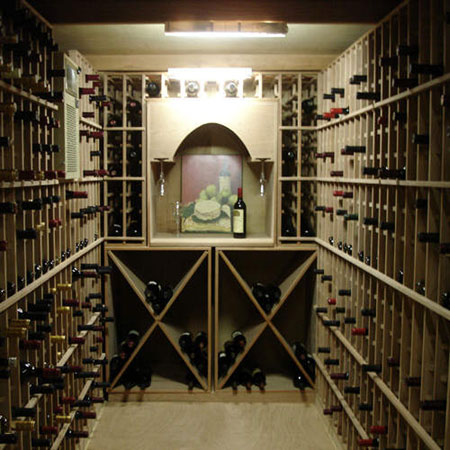
...or a whole actual walk-in cellar...


...you will be able to age your wine with confidence that it is being properly stored.

If you don’t plan to go out and buy a cellar, you can always do the tried-and-true method of laying the bottles down in a remote place in a closet. Closets are good because they are dark and generally are able to maintain a more consistent temperature than other places in the house. If you have a basement, a closet down there is even better because basements tend to be cooler than the rest of the house. Just make sure it’s a closet that is not frequently used, like a coat closet or the like. If it’s in the clothes closet, it is more likely to be jostled around when looking for a pair of shoes, or exposed to light if the closet is left open.

Good luck, and happy aging!

Source: Studio Vino

Wednesday, June 9, 2010

Wine Label Removal

First off, I'd like to take a moment to say I'm so very sorry! I did that last post (Wine Label Anniversary Project) and had no clue so many people would be so interested! Since I didn't expect it to be so gosh darn popular, it didn't occur to me to explain how to properly remove wine labels so they remain pretty and intact.

Heat your oven to 175 degrees.

Yes, you heard me right. We're not soaking, or using fancy "removers." We're using good old fashioned heat.

Once it's heated (which should take all of a minute and a half), put the empty, corkless wine bottle in the oven for 10-12 minutes.

Remove with a pot holder, and begin to peel slowly from one corner, being very careful not to go too fast or it will rip. Once you've got it removed, the sticky side will actually still be sticky, and you can now stick it to a piece of plain white computer paper. These collect really easily and you can keep them in a file until you're ready to cut them out and Mod Podge them to something fun!

The reason this works is because the heat melts the glue that adheres the label to the bottle. Based on my experience - and you can see that I have a LOT of experience - this method will work for about 90% of wine bottles from US-based winemakers. It gets a little trickier when we go country hopping. Old world wine countries (Italy, France, etc) sometimes tend to use more of a cement than a glue. For these, I've got nothin'. Sorry! But other countries with newer production methods (Australia, Chile) tend to lean toward the glue, which works great for this method.

If you're doing something similar with beer bottles, same rules apply.

Good luck! If you do something using wine labels, I'd love to see pics!

Photobucket

Sunday, June 6, 2010

Happy Anniversary!

Today is my anniversary with my wonderful husband. I can't believe another year has flown by! The reason I'm bringing this up on the blog though is because my anniversary gift to him last year was the straw that broke the camel's back; it was the first project I used Mod Podge to make since high school. It's also the first project that got me into the blogging world. As you can see, it's been a slippery slope!

One year ago....

Chris and I had been saving all of our wine labels in a book from that first year of marriage, and about a month before our anniversary, I got the bright idea to decoupage them into a piece of wall art to hang above our couch. I knew he'd love it because, 1) he LOVES wine, and 2) he didn't like the picture frames we had above our couch and was looking for a bigger piece of art to hang up there anyway.

So I ordered a plain canvas online, a 30"x30" canvas. It arrived, and I started to cut the wine labels out of the book, and you know what? It takes a TON of wine labels to cover a 30"x30" canvas! WAY more than we had. I think we had something like 25 or 30 labels... that hardly covered a corner of the thing. Needless to say, I couldn't finish this alone. So I called in the Moms. I begged them to please please please save all their wine labels from every bottle they consumed, and start mailing them to me so I could do this thing!

Well, because of my poor planning, I was only able to tell my husband about his gift, I had nothing to show him yet. And since I was getting help from family sending me wine labels, I decided to let them know the progress of the project by starting a little blog for them to follow along. I go back and look at it now, and still can't believe I wasn't able to finish the darn thing until October! But in the end, I am so proud of it; it really is one of my favorite Mod Podge projects I have ever done.

Wine Label Project edited(14)

Wine Label Project edited(15)


I then very clearly caught the crafting and blogging bug, because the Food, Wine, & Mod Podge blog you know and love today was started the very next month after I finished this project. And look how far we've come!

If you're interested in seeing the step-by-step for the wine label project, I do go through the whole process in the old blog. Hope you enjoy!

http://winelabelproject.blogspot.com/


**Note: For how to remove wine labels easily, go to my post on Wine Label Removal

Wednesday, May 19, 2010

Love by the Glass


Today I want to share with you a great book that was given to me by my mother-in-law. The book is called Love by the Glass, and it’s written by Dorothy Gaiter and John Brecher, the authors of the "Tastings" column in The Wall Street Journal. Gaiter and Brecher are a married couple who met as newbies in the journalism world, and newbies in the world of wine. Just as California was finding its identity in the wine industry, the couple starts to explore whites, reds, and especially sparkling/champagnes. The book follows them from meeting, to new jobs, the wine column, and kids, and intermixes their knowledge and love of wine.

The reason why I loved this book is because it was half life story, half wine textbook. They went into so much detail about the types of wines, their origins, their histories. Yet it all followed the storyline of their life and love, so you hardly noticed how much you were learning. In fact, there was so much information that I actually want to read it again to absorb more! Now regarding the storyline, their love story, it almost seemed fate how well everything layed out for them. Sure there were bumps in the road, which they talk about, but their love for each other, how they focused on building their relationship through wine, is something to truly strive for. It inspires you to be a better partner, with or without the wine!

It’s a wonderful read, I highly recommend you add it to your book list!

Sunday, May 2, 2010

When to hold and when to drink

How do you know when you should hold a wine for a long time, and when you should just drink it?

This by no means is an exact science, but there are some handy tips to help you decide.

At IntoWine.com, they break down the types of wines that generally age well, and those that don't.


Rittmaster has some suggestions. “White wines like German Riesling, French Vouvray, and Australian Semillon can age effortlessly for decades if they are in balance at the beginning,” he says.

Cabernet Sauvignons can be kept for two years and beyond, depending on the vintage and where they wine came from. Those from Bordeaux in France, Coonawarra in Australia, and even some from California’s Napa Valley do age well...

Wines that do not benefit from aging are Merlot, Pinot Gris, Sauvignon Blanc, Pinot Noir, and Chardonnay. Since there are many different styles of Chardonnay, treat each one as if it were a different varietal. All of these wines, in general, should be consumed young or only stored for under five years.


So now that you have an idea of which types of wine are good to hold and which to drink, this is still a little too much of a generalization. Next, you can break it down further by region and year.

Wine Spectator publishes a new vintage chart each year to help consumers make the call to hold or to drink. This chart lays it out by region (Argentina, Australia, Chile, France, Germany, Italy, Portugal, South Africa, Spain, US) as well as by year. They even have a handy pocket-sized Wallet Chart to print and keep with you.

Another yearly vintage chart is published by Robert Parker (aka Wine Advocate). I recommend you check out both charts, because they sometimes can be very different in their recommendations. Since there are many subjective factors that go into these recommendations, it's worth seeing what different authorities think. A warning though, the Robert Parker vintage chart is a little harder to read, but also provides more guidance than Wine Spectator's "Drink" or "Hold."

Sometimes it's a hard decision, but hopefully the resources above, as well as your own research, will help make it a little easier.

The next post on wine will take on the actual aging process. Once you've picked your wines you want to age, how do you do it? We'll go through a brief overview of the why's and how's of aging wine.

Sunday, April 25, 2010

Why Decant?

decanter 2


What is decanting? Why should I do it?

Many people have seen others decant wine before drinking it without knowing why. Moreso, many people decant wine themselves without knowing why. There are many benefits to decanting, but it's good to know how and why they work.

First of all, decanting is really beneficial only to red wines. Yes, there may be some white wines which are meant to age and thus could possibly benefit from decanting, but as a general rule, only red wines are decanted.

Now, what happens when you decant wine? Decanting allows oxygen to enter the wine. The wine has been sitting in a barrel/bottle for a very long time without any access to oxygen. Though oxygen is a bad thing for the aging process (think of a corked bottle...tastes like vinegar), a little bit right before drinking helps mellow out the flavors and develop depth and complexity.

Not sure what I mean when I say words like "mellow, depth, and complexity?" Try out this experiment. Get a young bottle of cabernet sauvignon. Young being about 3 years old. Open it, and immediately pour a small amount into a glass. Try it, see what stands out. Then pour the rest in a decanter. 1 hour later, try a little more. Then 2 hours, and 3 hours. If you're having a party of people over, you can also try it the opposite way. Take 4 bottles of wine, decant one of them 3 hours before drinking, one 2 hours, and one 1 hour before drinking. Then open the final bottle when ready to drink. Pour all four glasses side by side, and taste in progression from most recent to longest, and see how the flavors have developed.

The reason I suggest doing a young red is because the benefits are most greatly observed with these younger reds who are very tannic and even harsh when first opening. Decanting allows them to become more drinkable and pleasant. That being said, there is a lot of argument for much older wines whether decanting is beneficial or even necessary. Although most agree that decanting is good for older wines for the purpose of removing the sediment, the argument stands that old wines do not need more air because they have been left to age for so long, their depth of flavor is already developed. Whether this is true or not depends on who you speak with; however, most agree that decanting a young red for at least 1-3 hours definitely benefits the wine.

If you have a moment, I highly recommend watching this episode of Wine Library TV. He's a little intense about decanting, and his example wine is a very expensive bottle, but even at the end he mentions even the $8 bottle of wine can really benefit from decanting.

decanter 1


Do I have to have a fancy, expensive decanter?

No. The only recommendation I can even find online is to make sure to purchase a clear glass/crystal decanter so you can see the wine, see any sediment, etc. Other than that, any decanter will do. From the very simple, shown above, to the completely absurd:

decanter 3


What if I don't have 3 hours to spare to decant?

There are some "home remedies" and available contraptions out there to speed up the breathing process.

An older trick I've heard of is whipping the wine around in a blender a couple of times to quickly force some air in. Does it work? Who knows. Will it do any harm? Probably not. Will you look silly if anyone is watching you? Probably.

Some newer tools are being sold lately that boast the ability to "aerate" the wine. The Vinturi boasts "All of the taste with none of the wait." With this device, sold for about $40 and found everywhere, you hold it over the wine glass, and pour the wine through it. You can hear it bubbling through, forcing air into it. The Soiree is a device that attaches to the neck of the bottle and thus doesn't require any additional effort while pouring. It works by sloshing the wine around a bit before letting it hit your glass.

Both of these tools have essentially the same goal: speed up the breathing process. There are plenty of people out there who think they do help quite a bit, and others who think it's a lot of hooey. I'd guess they help a little more than just pouring straight into a glass, but not as well as decanting for 3 hours or more. Whether you see any noticeable different is up to you!

And finally, the old standby, just swirling it around in your glass. You see so many people doing this, and most don't even notice they're doing it. This helps keep the wine moving, adding air and breaking down the tannins. While it doesn't compare to a couple hours of decanting, it does continue the breathing process.

No matter your method, it is a fairly well-accepted ideal that decanting wine can help open up the flavors in a great young red, regardless of price.